Electronic Leak Detection in Pflugerville, TX
Electronic leak detection uses acoustic ground microphones to hear water escaping a pressurized pipe under the slab. We connect Pflugerville homeowners with local providers. Call (512) 877-2924.
Call (512) 877-2924- Free call, no obligation
- Phone answered 24/7
- Local provider explains cost before work
What happens when you call?
- 1Tell us what you see: a warm floor, a high bill, or running water.
- 2We connect you with a local provider who serves your area.
- 3The provider explains options and cost before any work starts.
When should you call about electronic leak detection?
- You hear running water with every tap off
- Your water meter moves when nothing is on
- Your bill jumped with no change in use
Related guide: how to run a meter test first.
For businesses, see commercial slab leak detection.
Not sure it is a slab leak? Call and describe what you are seeing. The call is free.
Call (512) 877-2924What should you do right now?
- Shut off the main water valve. It is in the meter box near the street, or where the main line enters your garage or an outside wall. Turn it clockwise until it stops.
- Warm floor? Close the cold-water inlet on top of the water heater.
- Water near outlets? Stay away. Switch off the breaker only if you are on dry ground.
- Smell gas? Leave and call your gas utility or 911 from outside.
What will the local provider do?
- Pressure-test the supply lines
- Listen across the slab with ground microphones
- Mark the loudest point on the floor
- Explain your repair options
Start with slab leak detection in Pflugerville if you are not sure what you need.
What causes the problems electronic leak detection finds?
Acoustic detection is used when a leak is suspected but nothing is visible. Most of the leaks it finds under Pflugerville slabs come from a few common causes.
- Copper lines wearing thin where they rub against concrete or rebar
- Joints loosened by slab movement in clay soil
- Pinholes from years of hard, mineral-rich water
- Nail or screw damage from past remodeling work
Which warning signs matter most?
| Sign | What it may mean | Urgency |
|---|---|---|
| Faint hiss near a floor or wall at night | Pressurized water escaping | Today |
| Meter leak indicator spins with taps off | Active leak after the meter | Today |
| Low pressure at one fixture only | Leak on that branch line | This week |
| Bill up 20% or more with no change in use | Hidden leak somewhere in the system | This week |
What should you expect?
Acoustic detection works best when the house is quiet. Providers may ask you to turn off fans, the fridge ice maker and irrigation during the test so background noise does not mask the leak.
How can you prevent it?
- Check your water meter with everything off every few months
- Keep house water pressure in a normal range; very high pressure strains pipes
- Note any new floor cracks after big weather swings
- Tell remodeling crews where supply lines run before they drill or nail
How does electronic leak detection find a leak you cannot see?
Water escaping a pressurized pipe makes noise. At a pinhole or cracked joint, the water rushes out and creates a hiss or vibration that travels through the pipe, the soil and the concrete. Acoustic detection uses ground microphones and amplifiers to pick up that sound through the floor.
The technician first isolates the lines, often by shutting off the water heater supply or specific valves, to learn whether the leak is on the hot side, the cold side or the main line. They then trace the likely pipe path across the slab and listen at points along it. The sound is loudest right above the leak, and the spot is marked on the floor.
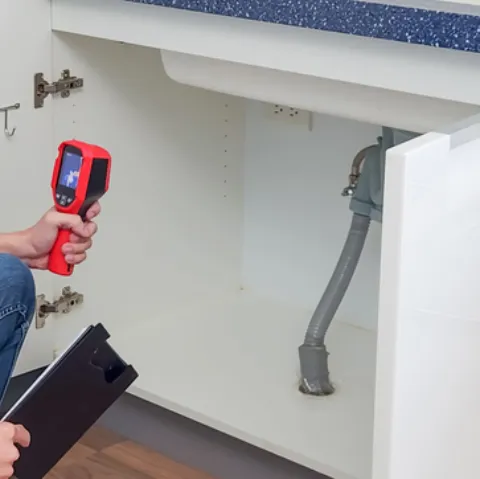
Many providers pair acoustic listening with other tools. A line tracer can send a signal down the pipe so its path can be followed from above. A pressure gauge confirms the line is losing pressure. Thermal imaging can show a warm patch when a hot line is leaking. Using more than one tool narrows the search and makes the mark more reliable.
What tools might the technician use?
| Tool | What it does |
|---|---|
| Ground microphone | Listens through concrete for the sound of escaping water |
| Pipe or line locator | Traces where the pipe runs under the slab |
| Pressure test gauge | Shows whether a line holds pressure or drops |
| Thermal camera | Shows heat patterns from hot water leaks |
| Tracer gas | A safe gas pushed through a drained line and sniffed at the surface |
Tracer gas is useful when a leak is too quiet to hear, such as a very small leak or one under thick flooring. The line is drained, filled with a mix that is usually hydrogen and nitrogen, and a sensor picks it up where it escapes.
How should you prepare for the visit?
- Know where your main shut-off and water heater valves are
- Clear furniture and rugs from the area you suspect
- Turn off appliances that run water, such as the dishwasher, washer and ice maker
- Keep pets and children in another room; the work needs quiet
- Have recent water bills handy if usage has jumped
- Note any warm spots, damp baseboards or cracks you have seen
The quieter the house, the better. HVAC fans, pool pumps and even a busy street can add background noise, so the technician may ask to turn equipment off for a short time.
What limits electronic detection?
Acoustic detection works best on pressurized water lines. It is less useful for drain lines, which are not under pressure and are better checked with a camera. Very thick tile, deep pipe runs and noisy surroundings can also make leaks harder to hear.
No tool can see through concrete. The mark on the floor is an informed estimate, usually close enough to plan a small, targeted opening. Ask the provider how confident they are in the mark and what they will do if the pipe is not exactly where expected when it is opened.
What should the detection report include?
A good report lists which lines were tested, which held pressure and which did not, the methods used and where the leak was marked. It may include photos of the mark and notes on the pipe material. Keep this report. It is what a repair provider works from, and it can help with an insurance claim.
How long does electronic leak detection take?
Most homes take a few hours. Simple cases, where one line fails a pressure test and the leak is loud, can be marked quickly. Larger homes, quiet leaks and long pipe runs take longer, because the technician has to trace each line and listen at more points. If tracer gas is needed, add time to drain and fill the line. Ask for a rough time window when you book so you can plan to be home, and ask whether the price is fixed or depends on time spent.
Where in Pflugerville can you get electronic leak detection?
- Electronic Leak Detection in Blackhawk 78660
- Electronic Leak Detection in Windermere 78660
- Electronic Leak Detection in Falcon Pointe 78660
- Electronic Leak Detection in Villages of Hidden Lake 78660
- Electronic Leak Detection in Highland Park 78660
- Electronic Leak Detection in Heatherwilde 78660
- Slab leak detection in Avalon 78660
- Slab leak detection in Sorento 78660
- Slab leak detection in Carmel 78660
- Slab leak detection in Springbrook 78660
- Slab leak detection in Commons at Rowe Lane 78660
- Slab leak detection in Northtown Park 78660
- Slab leak detection in Brookfield 78660
- Slab leak detection in Cambridge Heights 78664
- Slab leak detection in Park at Wellspoint 78664
- Slab leak detection in Verona 78660
- Slab leak detection in Bohls Place 78660
Related services
Electronic Leak Detection questions
Is electronic leak detection loud or messy?
No. The equipment listens from the floor surface. Nothing is cut or drilled to find the leak.
Does it work through tile and wood?
Yes. Ground microphones pick up leak sound through most hard and soft floors.
Which areas do you take electronic leak detection calls from?
All of Pflugerville, TX, across ZIP codes 78660 and 78664.
Does it cost anything to call?
No. Pflugerville Slab Leak Specialists is a free referral service. The provider explains their costs before work starts.
How long does electronic leak detection take?
Many homes take a few hours. Larger homes or leaks that are hard to isolate can take longer.
Do I need to be home during detection?
Usually yes, so the provider can reach the water heater, shut-off valves and fixtures.
Can it find more than one leak?
Yes. Each line is tested and listened to, so separate leaks can be found in the same visit.
Is electronic leak detection safe for my home?
Yes. It uses sound, signals and pressure readings from above the floor. Nothing is cut or drilled during the detection itself.
Can it find more than one leak?
Yes. Each line is tested separately, and a second leak on the same line can often be heard once the first is marked.
How accurate is the mark?
Usually within a foot or two. The provider can tell you how confident they are before any repair is planned.
Need help now?
Shut off the main valve if water is showing, then call. The phone is answered 24/7.
Call (512) 877-2924